
Aer One Air-Quality Monitor.
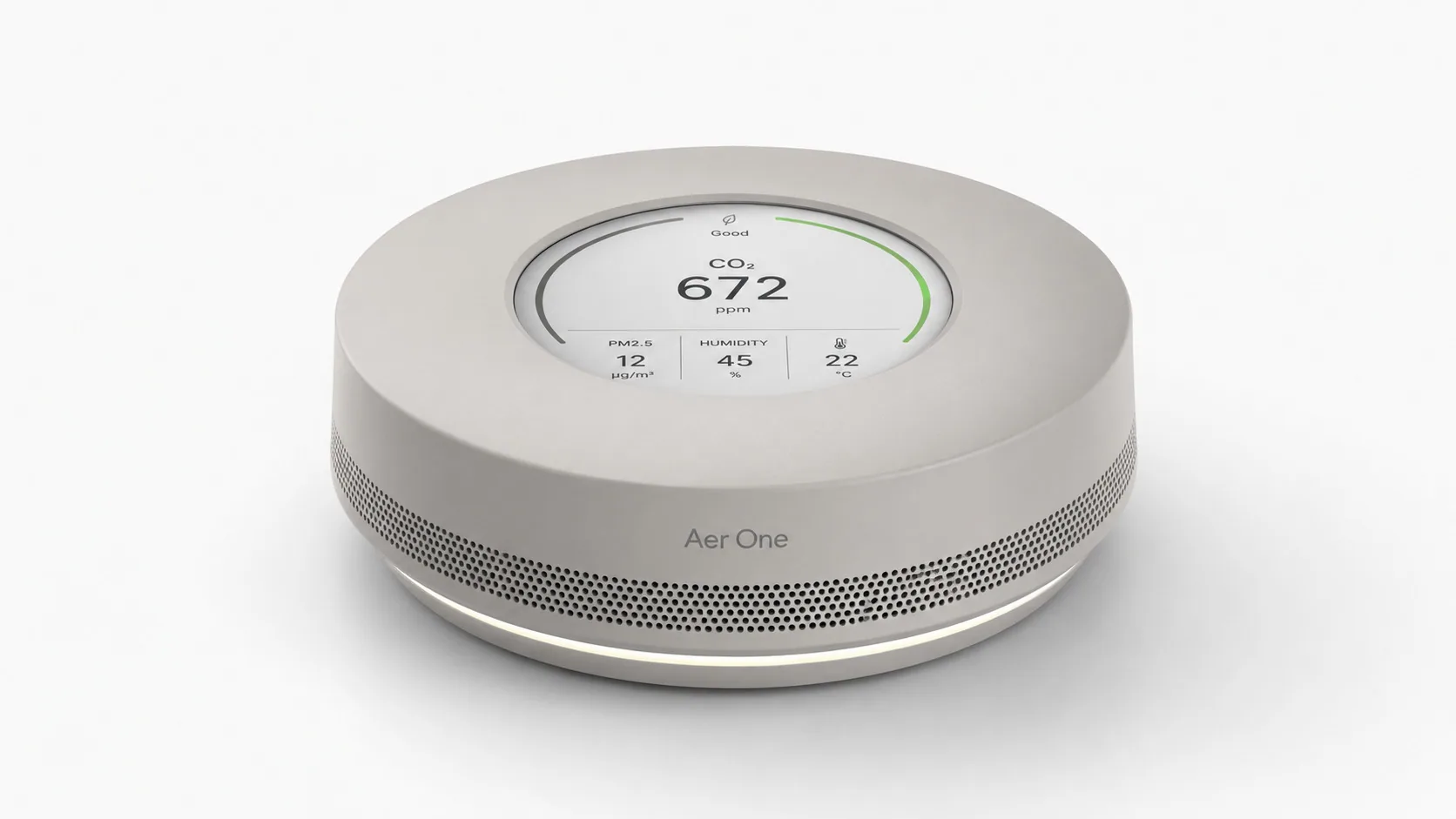
A desk-scale smart indoor air-quality monitor engineered to make essential environmental data visible without becoming another bright, noisy screen in the room.
At a glance
- The brief
- Most air-quality monitors force a trade-off: a bright LCD that dominates a bedroom at night, or a “silent” device that hides its data in an app. That trade-off creates three product failures: information is either visually intrusive, too difficult to access, or delivered through a device whose fan and heat distort the sensing experience.
- What we delivered
- Surge Robotics developed Aer One as a compact, always-readable indoor air-quality monitor built around a circular e-ink display, a controlled sensing path and a near-silent airflow system.
Key figures
A finished, integrated product developed across design, engineering and validation.
Surge Robotics developed Aer One as a compact, always-readable indoor air-quality monitor built around a circular e-ink display, a controlled sensing path and a near-silent airflow system.
The product combines CO₂, PM2.5, humidity and temperature monitoring in a 90 mm desk-scale enclosure. A 360-degree micro-perforated intake band supports consistent sampling, while a recessed LED ring communicates room status at a distance without turning the product into a bright bedside display.
Engineering detail Show
Program status
5 v / 1 a
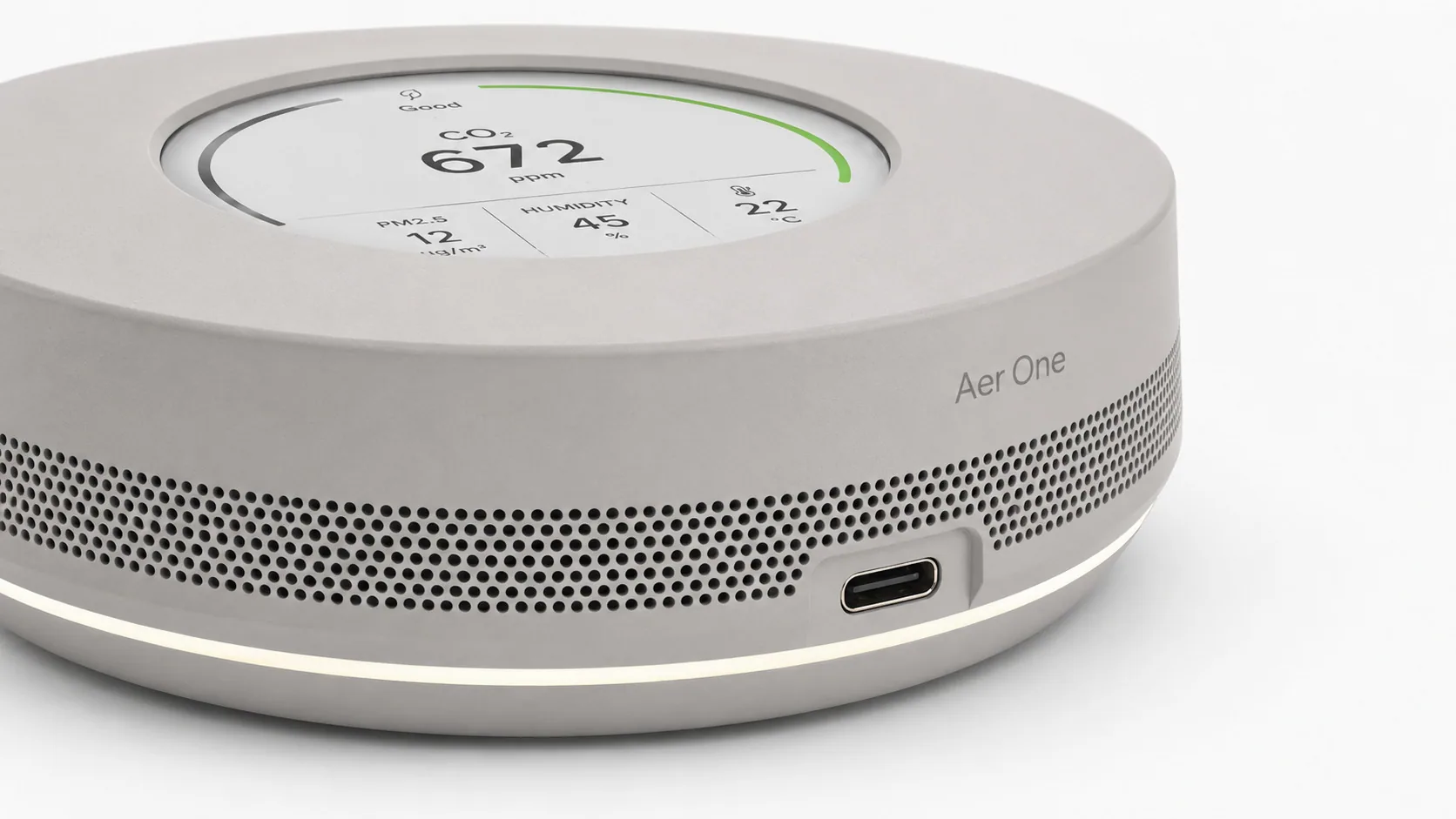
USB-C power input
- Always-on circular e-ink display
- 360° micro-perforated intake band
- Low-glare recessed status ring
- USB-C powered, near-silent airflow
- Circular PCB with integrated sensor array
- Two-part production-intent enclosure
Useful environmental data often comes with the wrong physical experience.
Most air-quality monitors force a trade-off: a bright LCD that dominates a bedroom at night, or a “silent” device that hides its data in an app. That trade-off creates three product failures: information is either visually intrusive, too difficult to access, or delivered through a device whose fan and heat distort the sensing experience.
Engineering detail Show
Design requirements
- Readable at a glance without opening an app
- No continuously illuminated display
- Near-silent operation in quiet rooms
- Stable sensing despite compact electronics packaging
- Small enough to disappear into desk, bedside or shelf
- Manufacturable as a clean two-part product assembly
Three failures we designed against
Conventional LCDs remain bright even when the user only needs ambient status.
App-only products add friction to a measurement that should be immediately visible.
Internal heat and poorly controlled airflow can undermine accuracy in compact monitors.
A calm physical product with a deliberately visible data hierarchy.
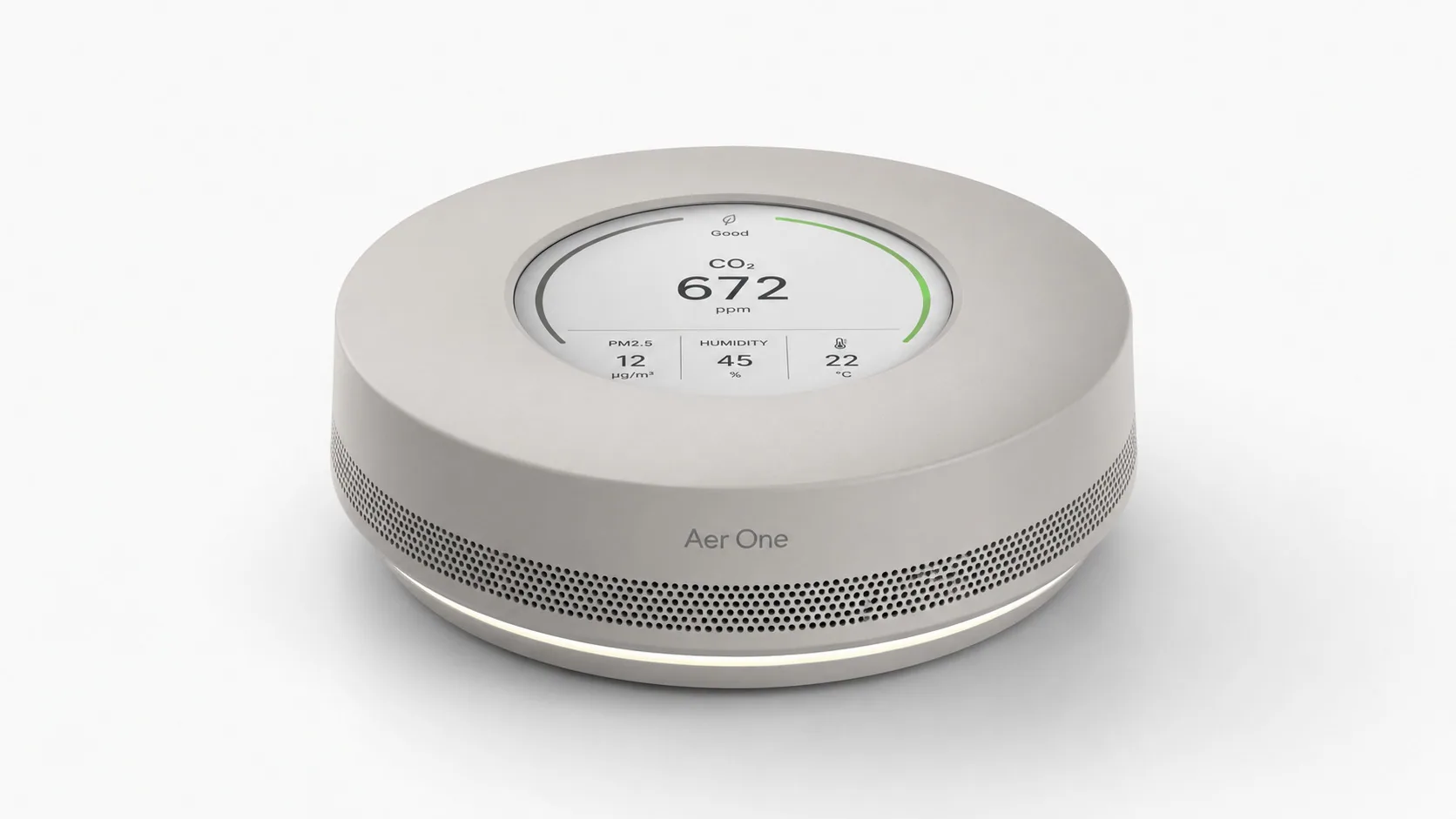
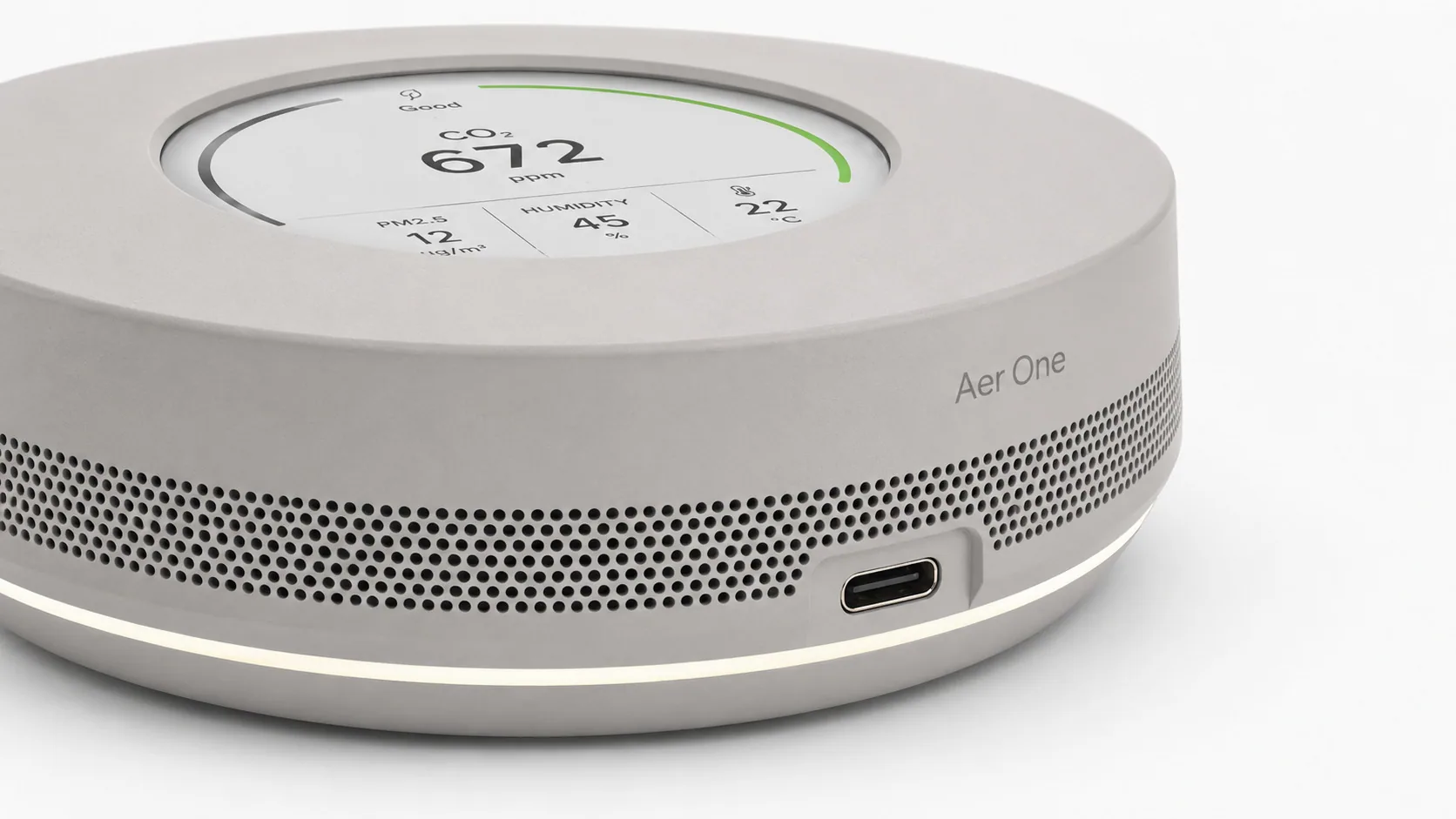
Aer One presents the dominant CO₂ reading first, then supporting PM2.5, humidity and temperature values — with an ambient status ring for a room-level signal.
Engineering detail Show
Readable without backlight emission, with negligible display hold power and no bedroom glare.
The micro-perforated perimeter band creates a large, unobstructed sampling path around the product.
A recessed LED ring surfaces air-quality state across the room without competing with the display.
Information architecture designed around a two-second glance.
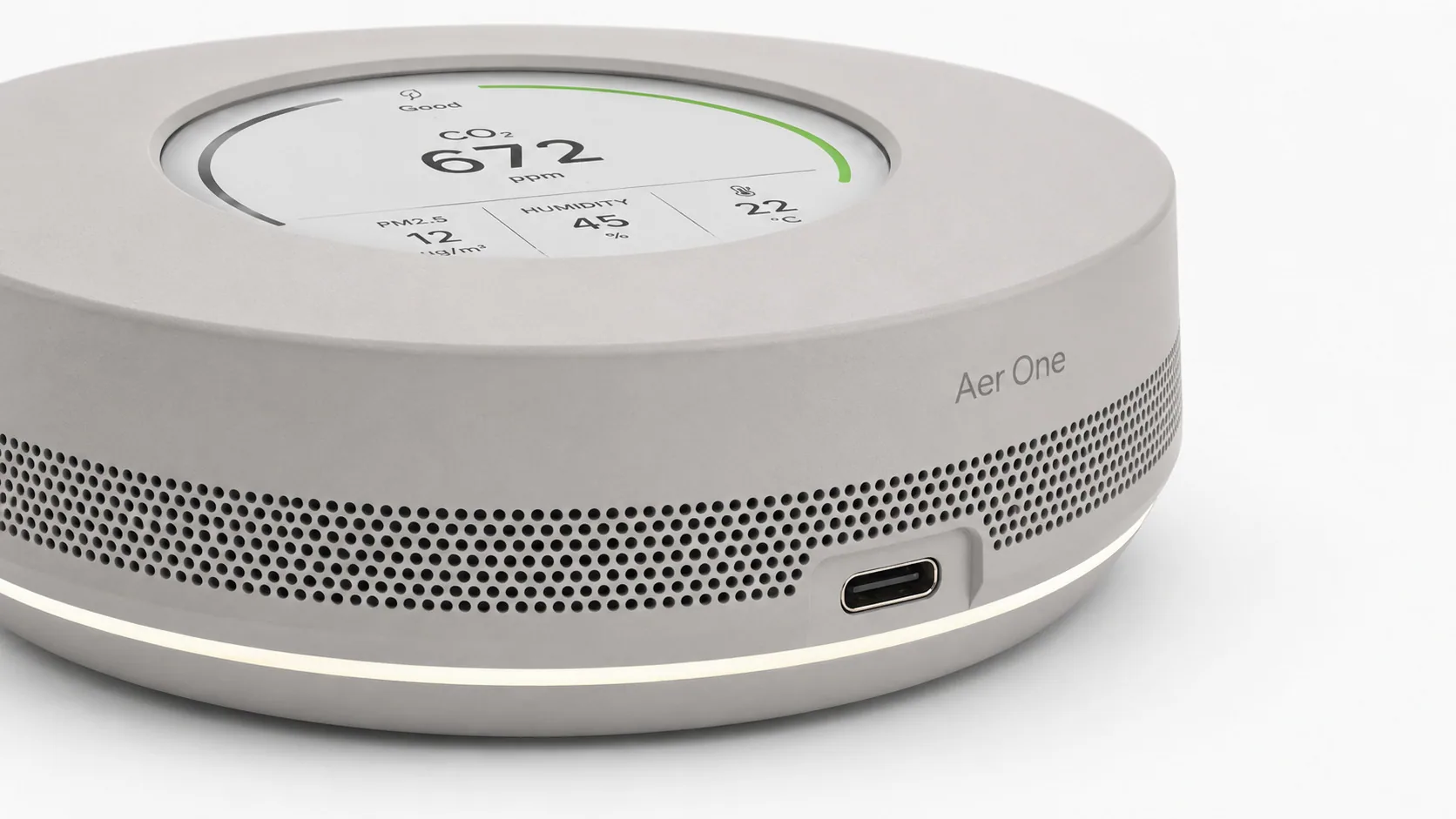
The main CO₂ value occupies the central field, supported by PM2.5, humidity and temperature in a stable lower row. Curved side indicators communicate the quality band without requiring the user to interpret a dashboard.
Engineering detail Show
One dominant environmental metric supported by three secondary readings and curved quality-band indicators.
E-ink prevents constant light emission; the LED ring is recessed and firmware-governed.
A single USB-C interface and minimal external controls preserve the appliance-like character.
A compact product language developed to sit naturally in domestic interiors.
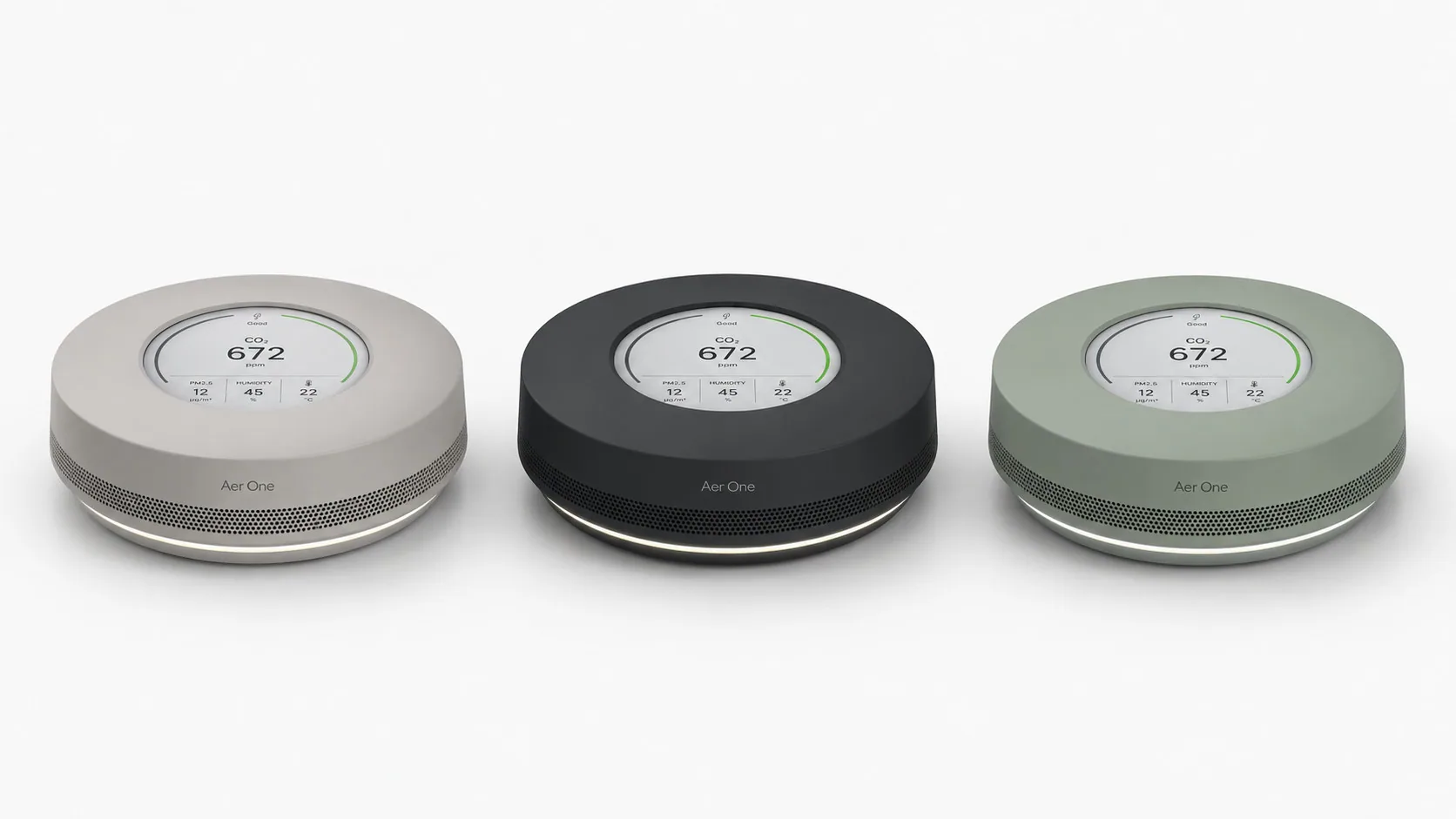
Three production colour directions demonstrate how one enclosure architecture can support distinct interior and brand applications — precise up close, quiet at a distance.
Engineering detail Show
Design principle
90 mm × 35 mm footprint keeps the product smaller than conventional monitoring displays.
The perforated band is both a technical airflow element and the primary visual signature.
The form supports light neutral, dark graphite and soft green finishes without changing the base architecture.
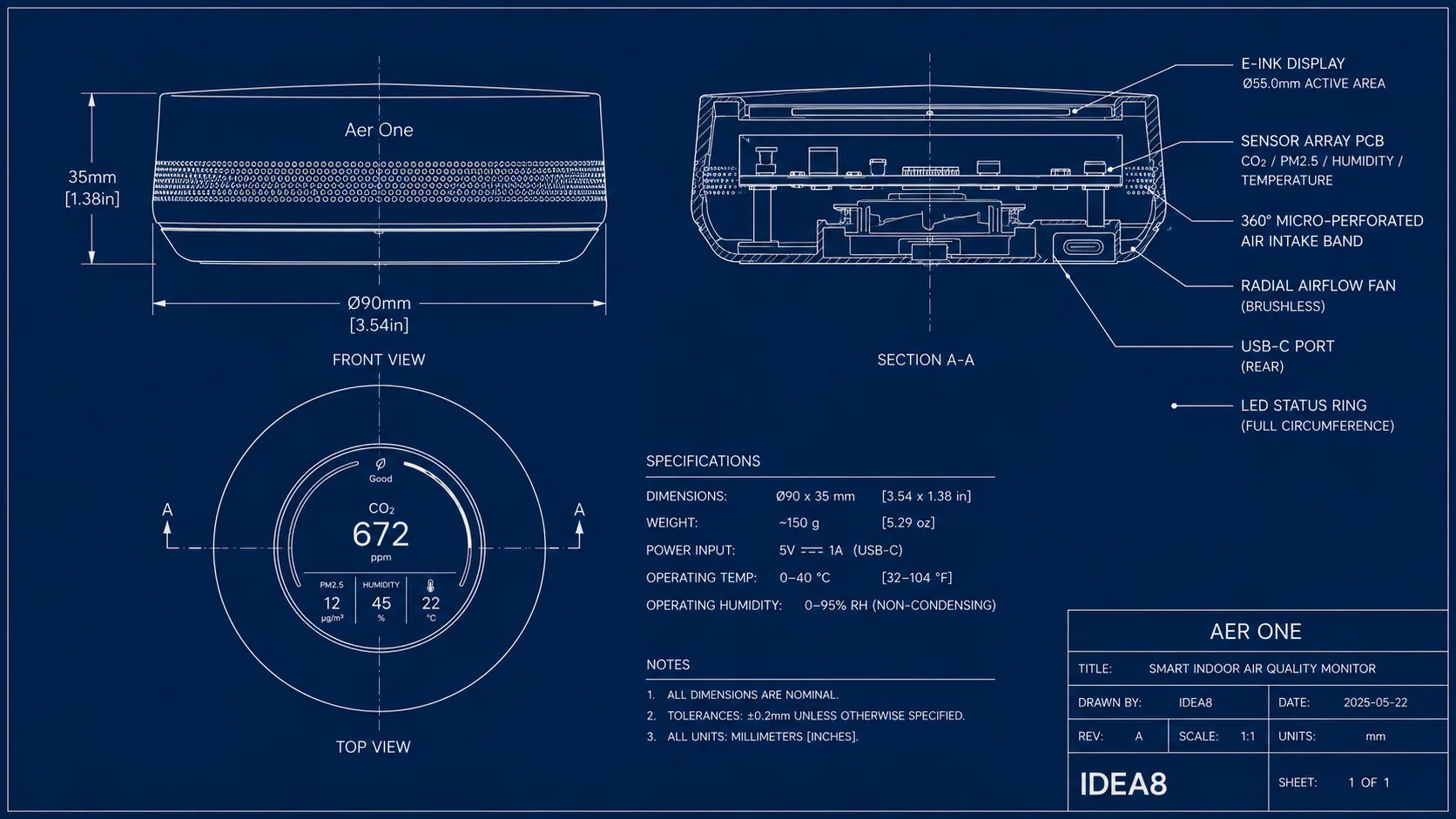
The sensing path was treated as the core product architecture, not an afterthought.
Engineering detail Show
Perimeter intake exposes the device to room air from all directions and reduces orientation sensitivity.
Stabilises airflow through the sensing cavity and supports repeatable refresh behaviour.
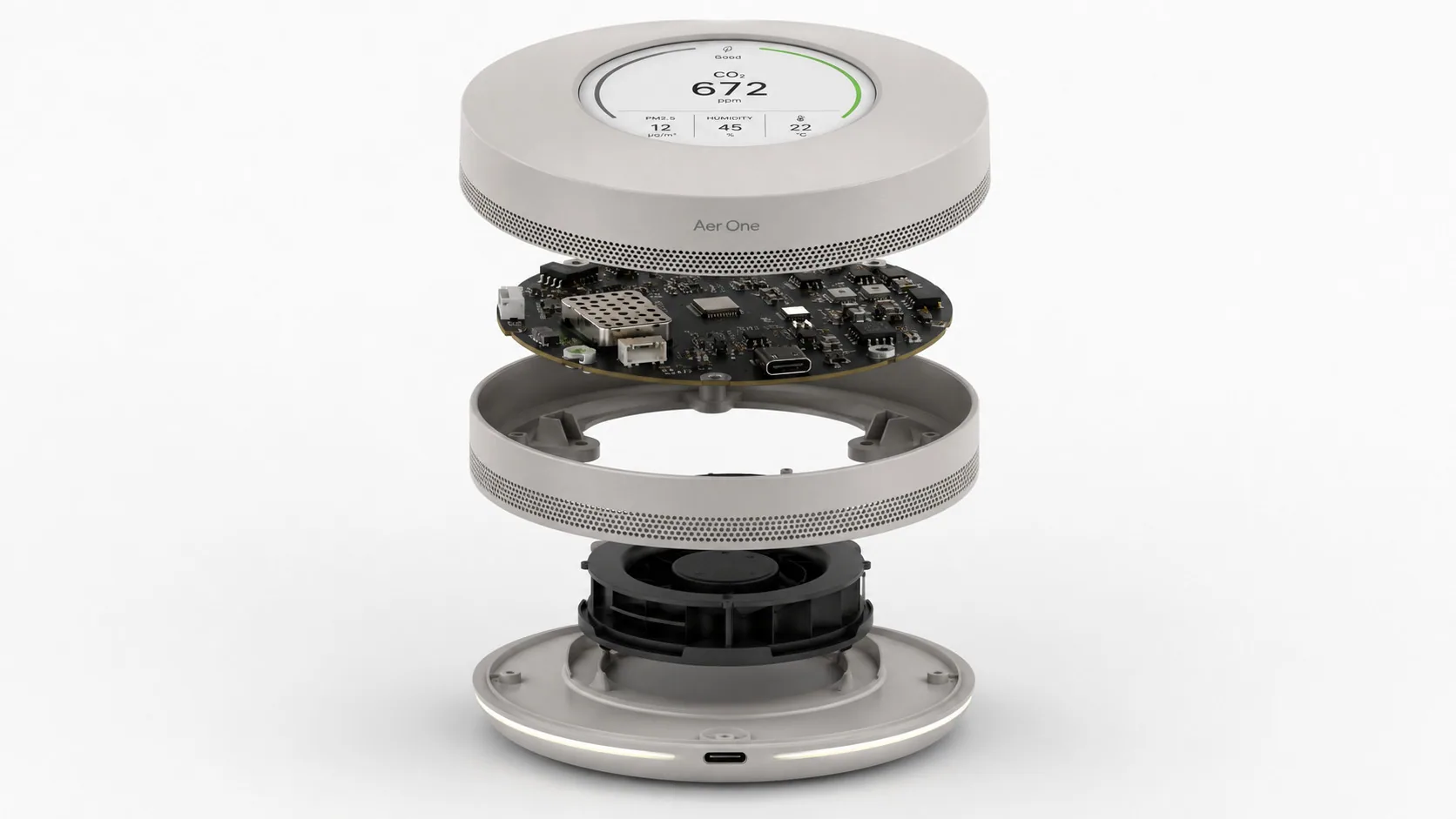
CO₂, PM2.5, humidity and temperature are processed for the e-ink interface, LED logic and connected data layer.
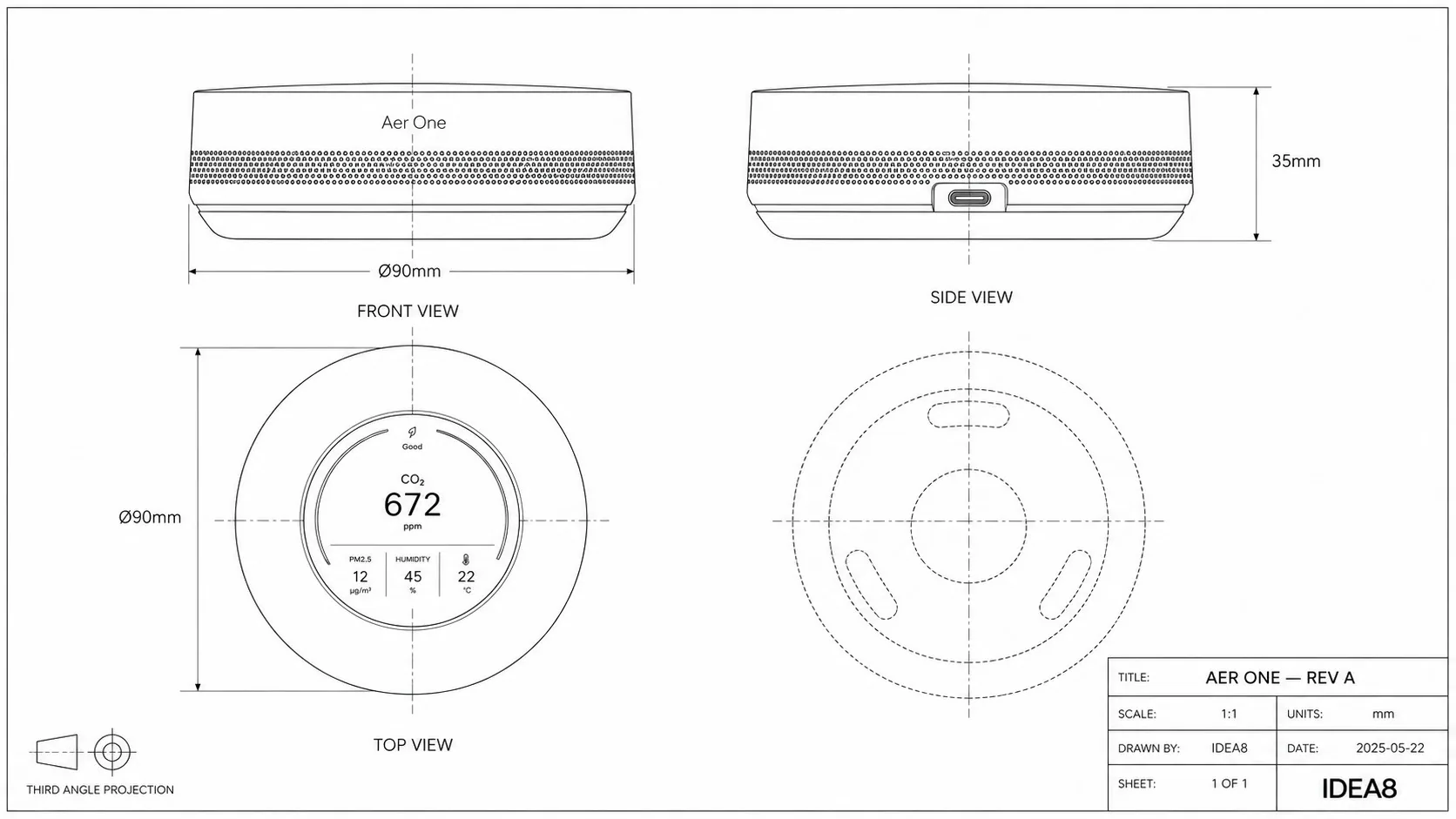
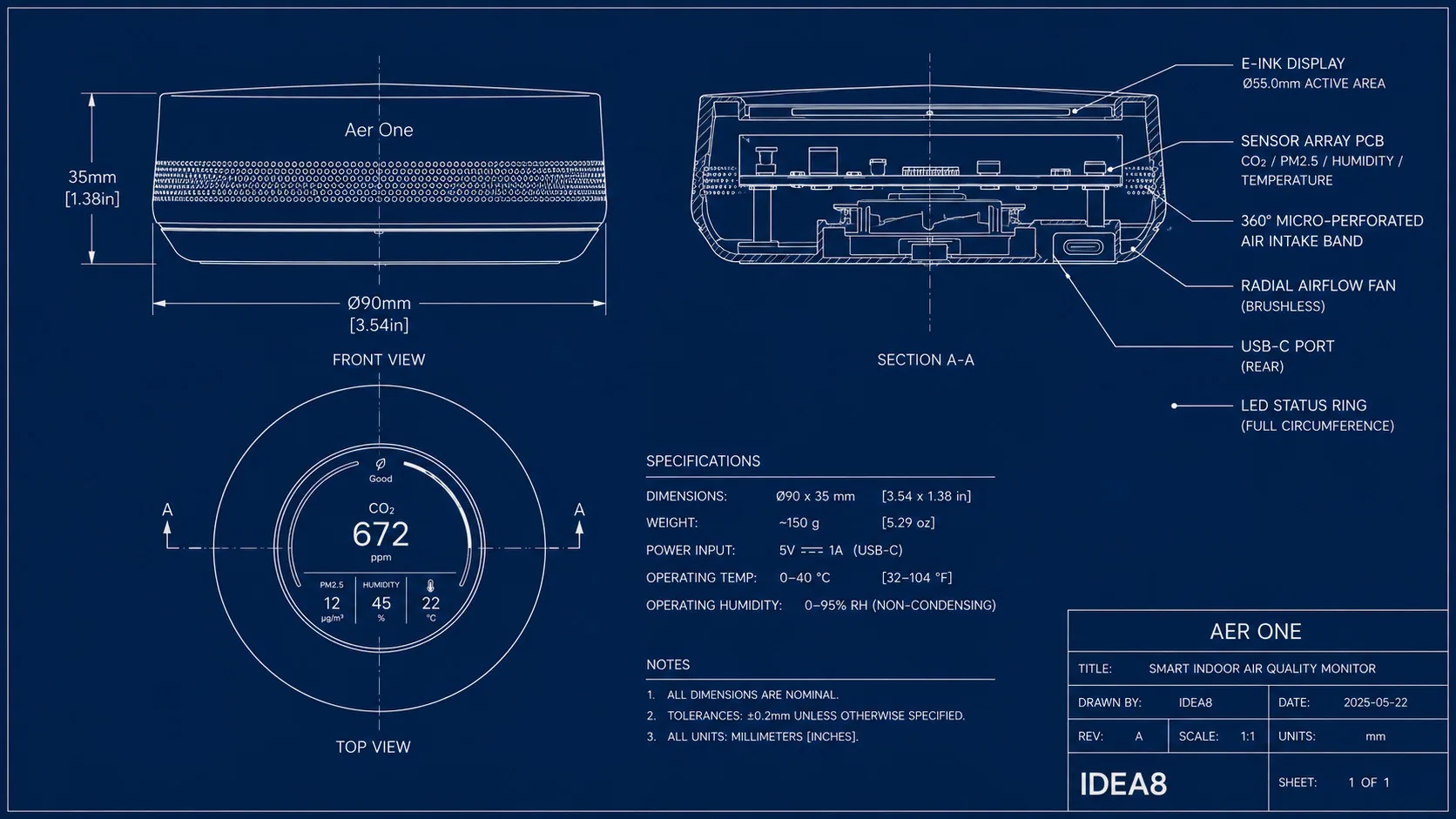
A 90 mm enclosure engineered around assembly, airflow and production constraints.
Critical tolerance chains were concentrated around the circular display opening, PCB support points, intake gap, USB-C interface and fan-to-cavity alignment. Cosmetic parting and gap lines were kept away from the primary viewing surface.
Engineering detail Show
- Two-part enclosure with clean split-line strategy
- Controlled intake band gap and perforation
- Circular PCB support and datum plan
- USB-C interface access with sealed edge
- Stable desk interface and controlled LED light escape
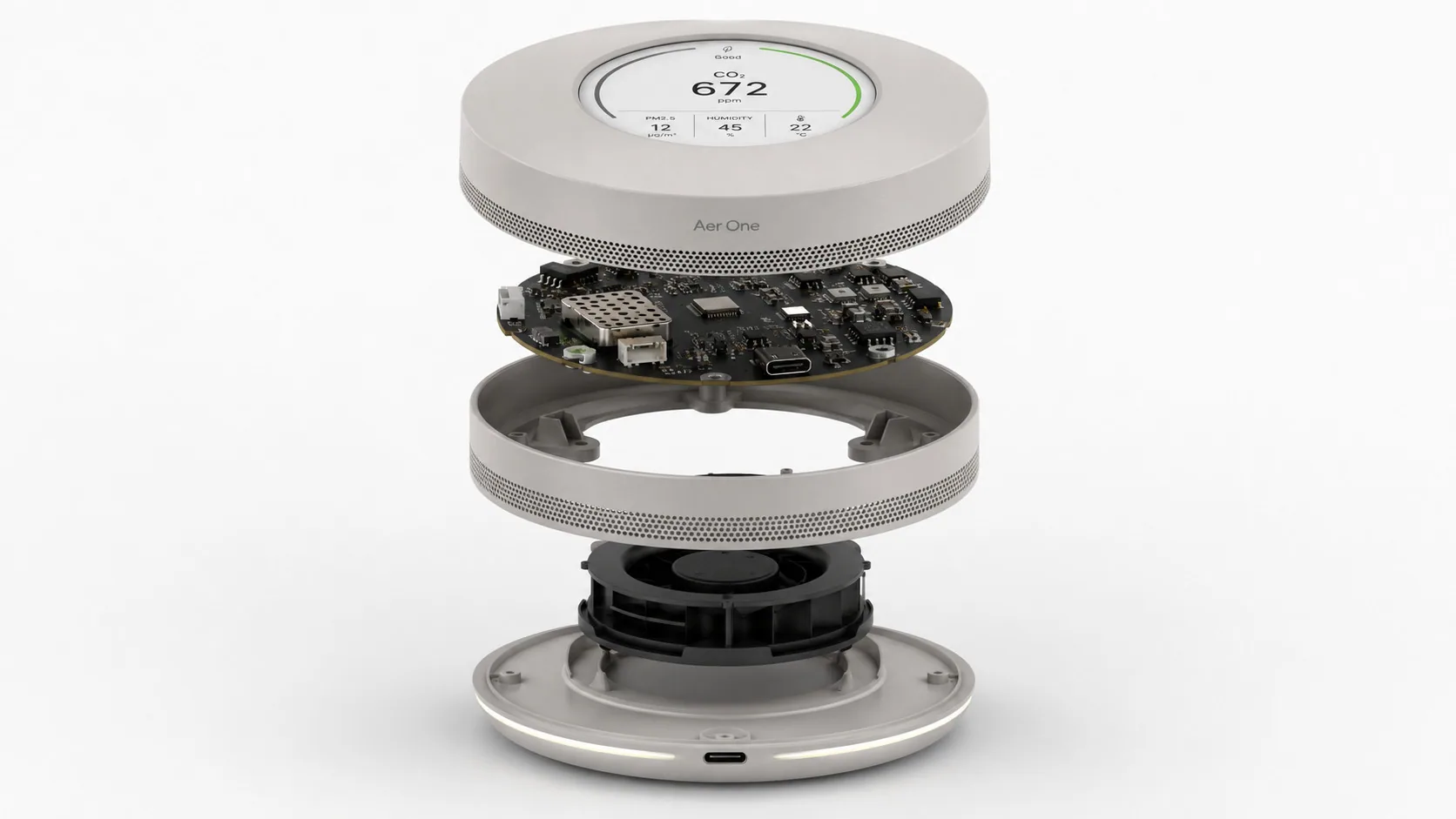
A circular electronics platform integrating sensing, power, display and connectivity.
The circular PCB architecture follows the enclosure geometry and preserves the central airflow/fan arrangement. Firmware treats acquisition, filtering, display refresh, quality-band calculation, fan-state management, fault handling, startup diagnostics and connected-data services as one coordinated embedded system.
Engineering detail Show
Design rule
Operating-state model
| State | Product behaviour |
|---|---|
| Startup | Power-rail check, sensor discovery, warm-up logic and display initialization. |
| Steady operation | Normal sampling, filtered output, quality-band mapping and calm LED state. |
| Sensor warm-up | Values held or masked until associated sensor is inside its valid state. |
| Degraded sensing | Fault communicated via display and status ring; unreliable metrics suppressed. |
| Service / update | Firmware update, calibration event or diagnostic mode without loss of status hierarchy. |
Engineering detail Show
Physical & environmental
| Product envelope | Ø90 × 35 mm |
|---|---|
| Target weight | Approximately 150 g |
| Form factor | Desk / shelf indoor monitor |
| Power input | USB-C, 5 V / 1 A |
| Operating environment | Typical indoor conditions |
| Enclosure strategy | Two-part molded assembly, controlled cosmetic surfaces |
| Intake | 360° micro-perforated perimeter band |
| Acoustic target | Near-silent operation in quiet rooms |
Sensing, interface & connectivity
| Sensing | CO₂, PM2.5, humidity, temperature |
|---|---|
| Airflow | Low-speed radial fan with controlled cavity |
| Primary display | Circular always-on e-ink |
| Ambient indicator | Recessed LED status ring, firmware-governed |
| Compute | Embedded microcontroller with sensor stack |
| Connectivity | Wireless data interface (details confidential) |
| User controls | Minimal external controls, USB-C interface only |
| Update path | Firmware OTA in controlled release channels |
SPECIFICATION GOVERNANCE: SENSOR PART NUMBERS, CALIBRATION LIMITS, WIRELESS PROTOCOL AND PRODUCTION RESIN ARE INTENTIONALLY EXCLUDED FROM THE PUBLIC CASE STUDY.
One multidisciplinary team from concept to validated hardware.
Engineering detail Show
Use case, user environment, product requirements, sensing priorities and acceptance criteria.
Form language, CMF, visual hierarchy, ambient behaviour and desk-scale integration.
Enclosure, intake band, airflow cavity, sensor mounting, PCB support and USB-C interface.
Circular PCB, sensor subsystem, power path, display driver, LED ring and connectivity.
Acquisition, filtering, warm-up, quality-band logic, fan management, fault handling and OTA.
Prototype builds, airflow, acoustics, thermal, sensor response and reference-instrument comparison.
Two-part enclosure strategy, perforation, wall/draft, gating, cosmetic risk and assembly sequence.
CAD, drawings, BOM structure, firmware package, test evidence and manufacturing intent.
Controlled design baseline, work instructions, inspection points and calibration governance.
A stage-gated plan linked every workstream to release evidence.
Engineering detail Show
01 / w1-2
Product definition & requirements
02 / w2-4
Industrial design & CMF
04 / w5-10
Mechanical & sensing architecture
05 / w6-12
Electronics & firmware bring-up
06 / w10-15
Integrated prototype & validation
07 / w14-18
DFM & production preparation
08 / ongoing
Scale & product support
Have a connected product to build?
Engineering detail Show
| Gate | Primary decision | Core deliverables | Release evidence |
|---|---|---|---|
| G0 | Product definition | Use cases, product requirements, sensing scope, environmental targets and success criteria. | Approved PRD, sensing brief, acceptance criteria and risk baseline. |
| G1 | Architecture approval | Sensing path, enclosure architecture, display and connectivity concept, thermal strategy. | System architecture, ICD, feasibility studies and rig evidence. |
| G2 | Detailed design review | CAD, PCB, firmware state model, perforation, fan selection and tolerance strategy. | Design review record, released prototype drawings, BOM and procurement package. |
| G3 | Integrated prototype | Working product build, sensor bring-up, airflow test rigs and display integration. | Integrated prototype units, issue log and validation plan. |
| G4 | Validation complete | Sensor accuracy, airflow, acoustics, thermal, mechanical assembly and firmware states. | Verification report with pass/fail evidence and closed corrective actions. |
| G5 | Production release | DFM, assembly sequence, inspection plan, calibration governance and supplier support. | Production BOM, drawings, work instructions, inspection plan and release configuration. |
CHANGE CONTROL: AFTER DETAILED-DESIGN GATE, ANY CHANGE TO PERFORATION, FAN, SENSOR POSITION, DISPLAY STACK OR ENCLOSURE RESIN REQUIRES A DOCUMENTED IMPACT REVIEW.

Have a product you’d like us to engineer?
Share the product, challenge or technical risk you are facing. We’ll come back with a clear technical next step — no sales pitch disguised as discovery.