
Kopi One Bean-to-Cup Platform.
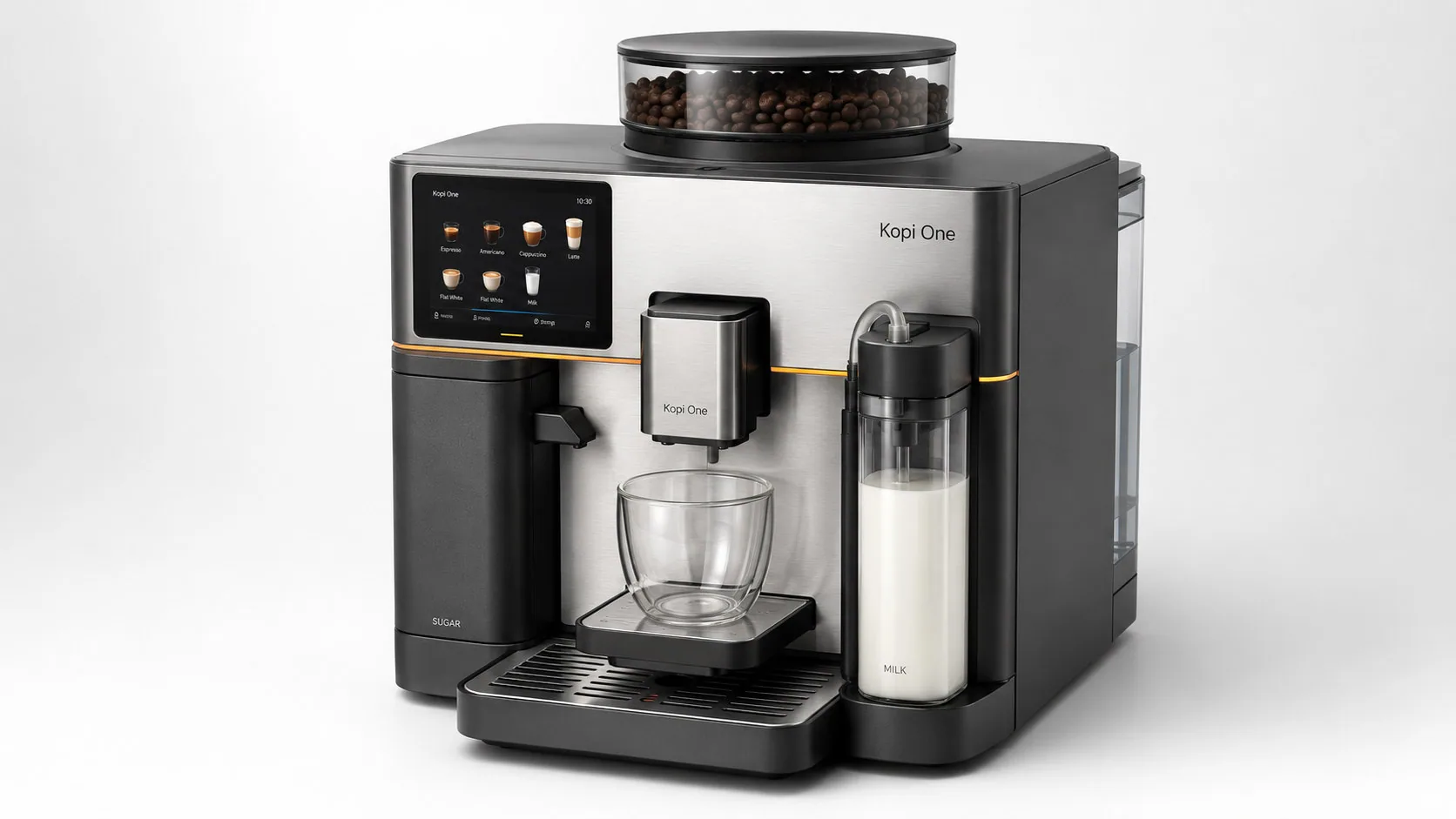
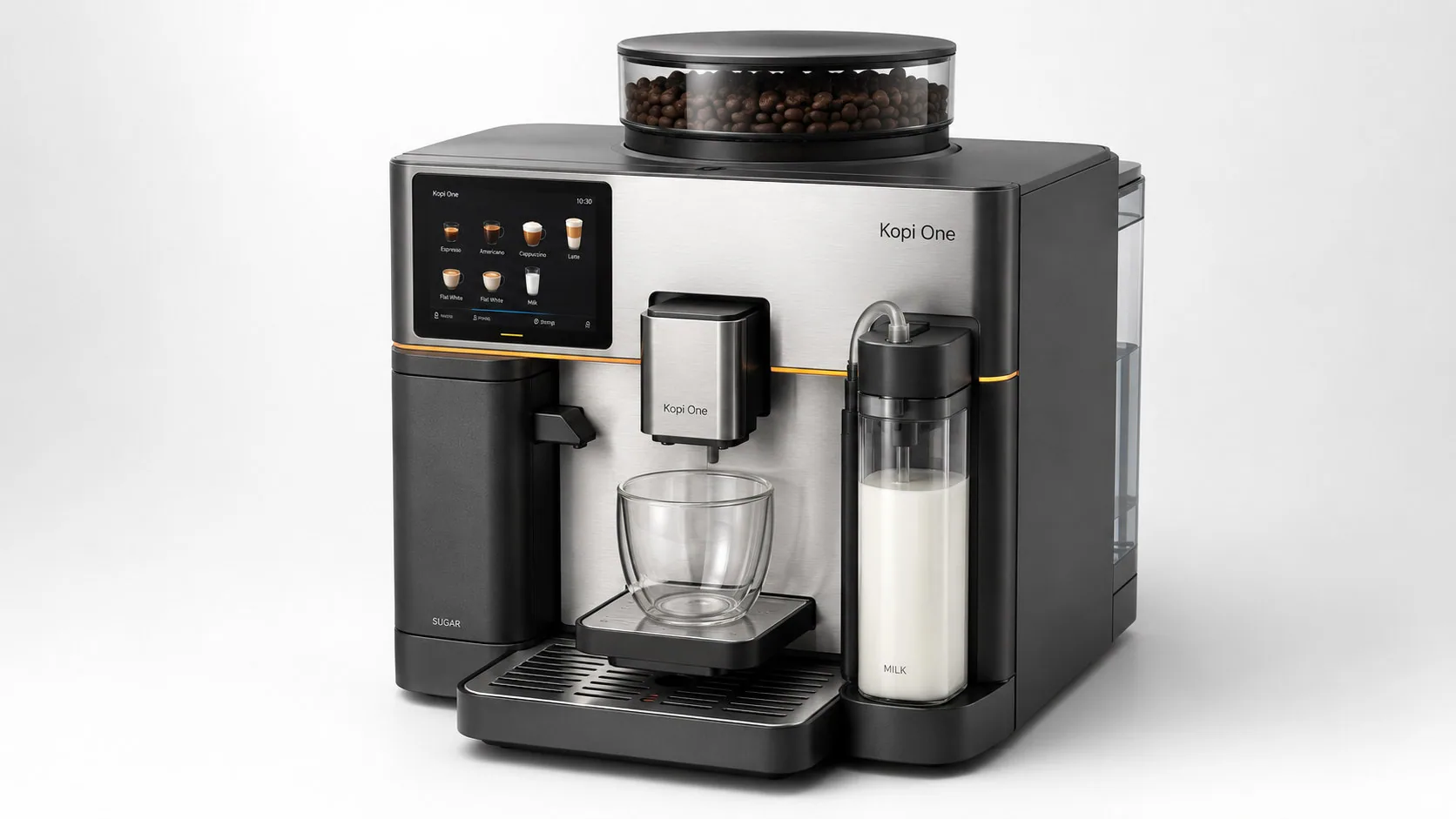
A compact bean-to-cup beverage platform integrating espresso extraction, milk frothing, precision sugar dosing and touchscreen recipe control — engineered as one countertop product.
At a glance
- The brief
- Conventional automatic coffee machines handle grinding and brewing, but still push key parts of the beverage workflow back to the user. Milk treatment, sweetness, portioning and cleanup are often separate manual tasks.
- What we delivered
- Surge Robotics developed Kopi One as a finished, integrated bean-to-cup machine that automates the entire drink sequence — beans, water, milk and sugar — while preserving user control through a recipe-based touchscreen interface.
Key figures
Five controlled process chains, engineered as one countertop product.
Surge Robotics developed Kopi One as a finished, integrated bean-to-cup machine that automates the entire drink sequence — beans, water, milk and sugar — while preserving user control through a recipe-based touchscreen interface.
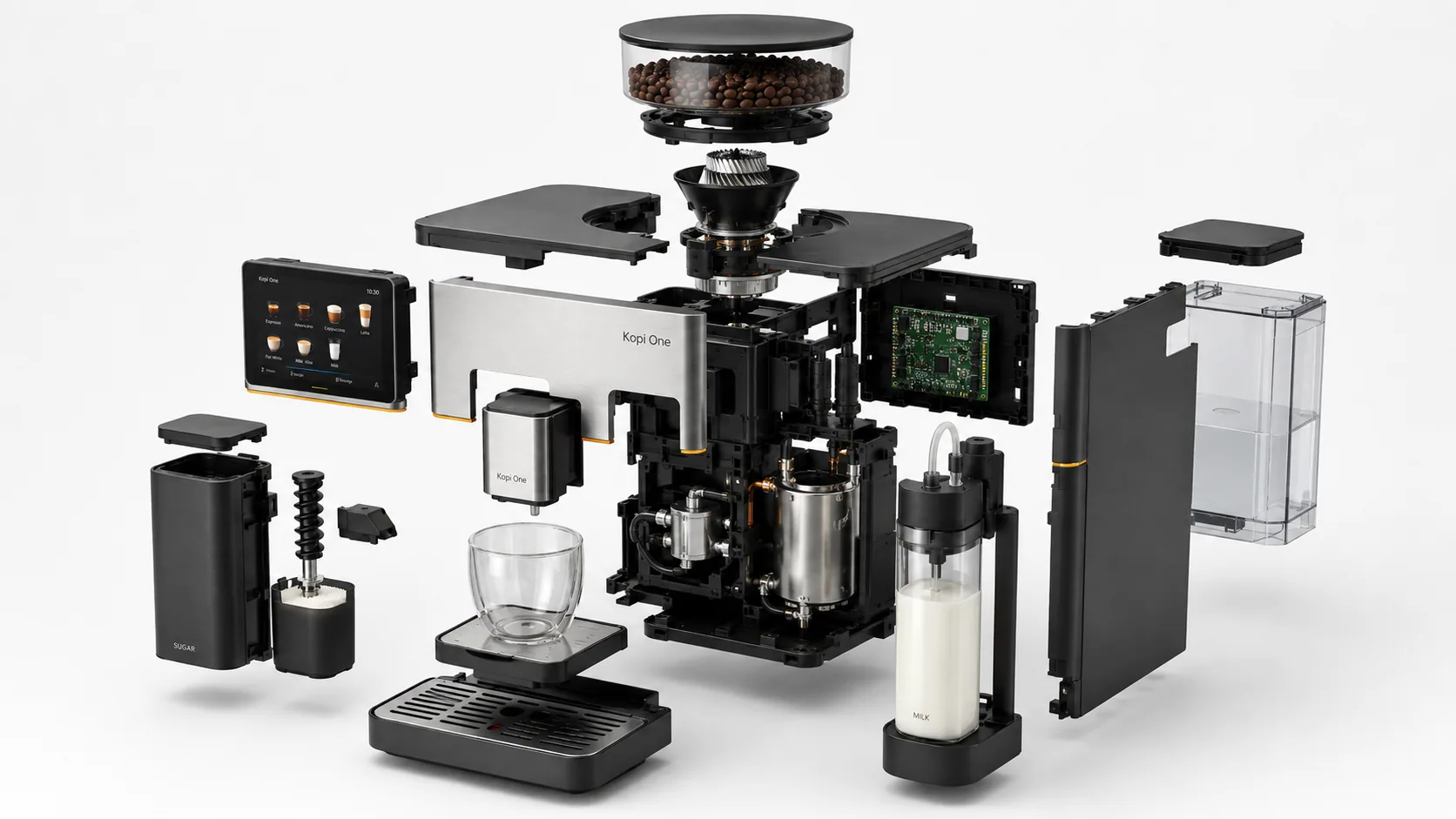
The central engineering challenge was not any single subsystem. It was packaging a grinder, brew group, thermoblock, pumps, food-contact reservoirs, a metering auger, power electronics and service access inside a 260 × 400 × 380 mm envelope without compromising thermal separation, hygiene, reliability or the customer experience.
Engineering detail Show
Removable water tank
0.6 l
Milk reservoir
- Integrated grinder, brew group and thermoblock
- Fresh-milk frothing with removable reservoir
- Precision auger sugar dosing
- Deterministic firmware state machine
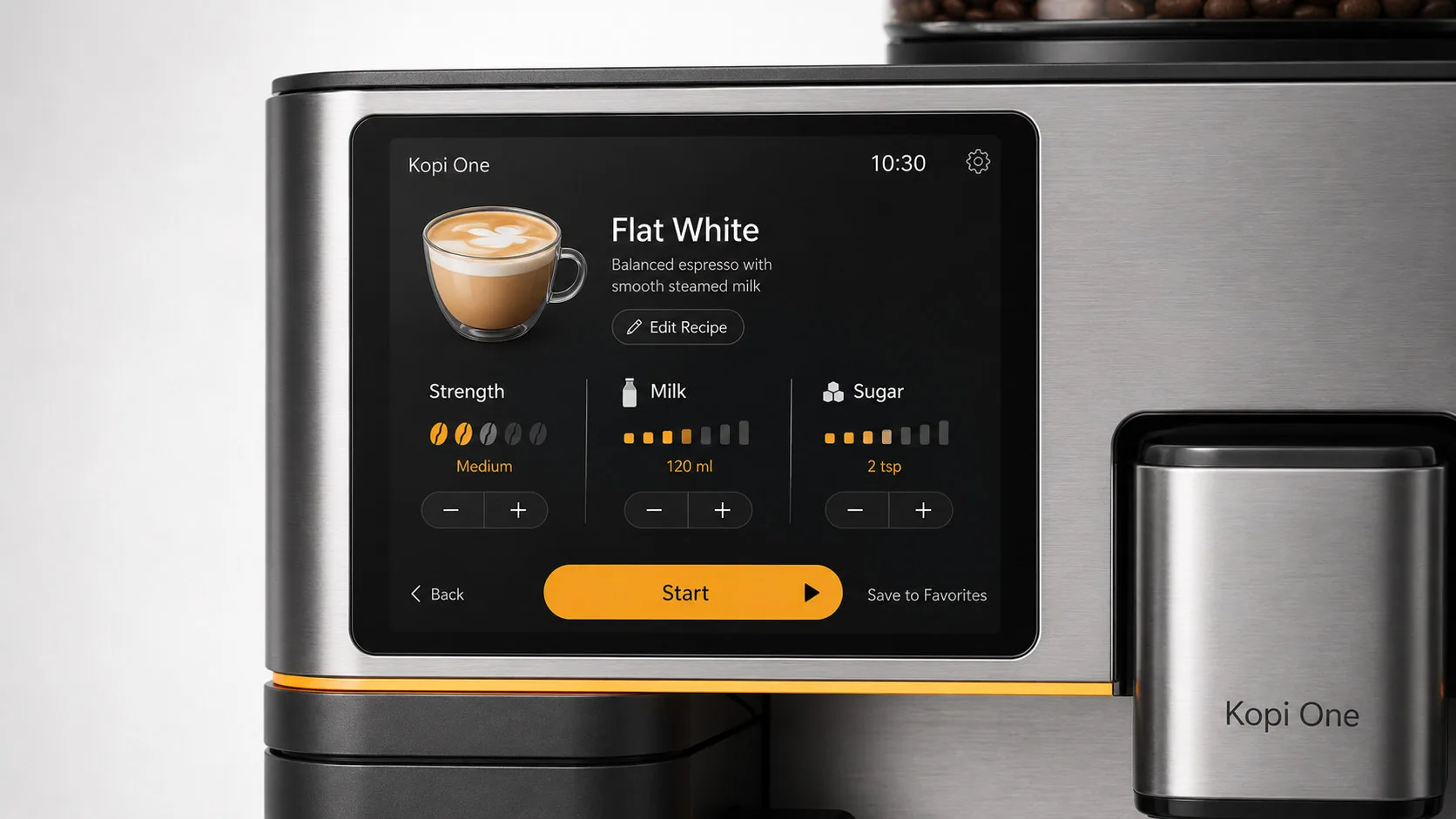
- Recipe-based touchscreen interface
- 260 × 400 × 380 mm countertop envelope
Convenience usually stops before the drink is actually personalised.
Conventional automatic coffee machines handle grinding and brewing, but still push key parts of the beverage workflow back to the user. Milk treatment, sweetness, portioning and cleanup are often separate manual tasks.
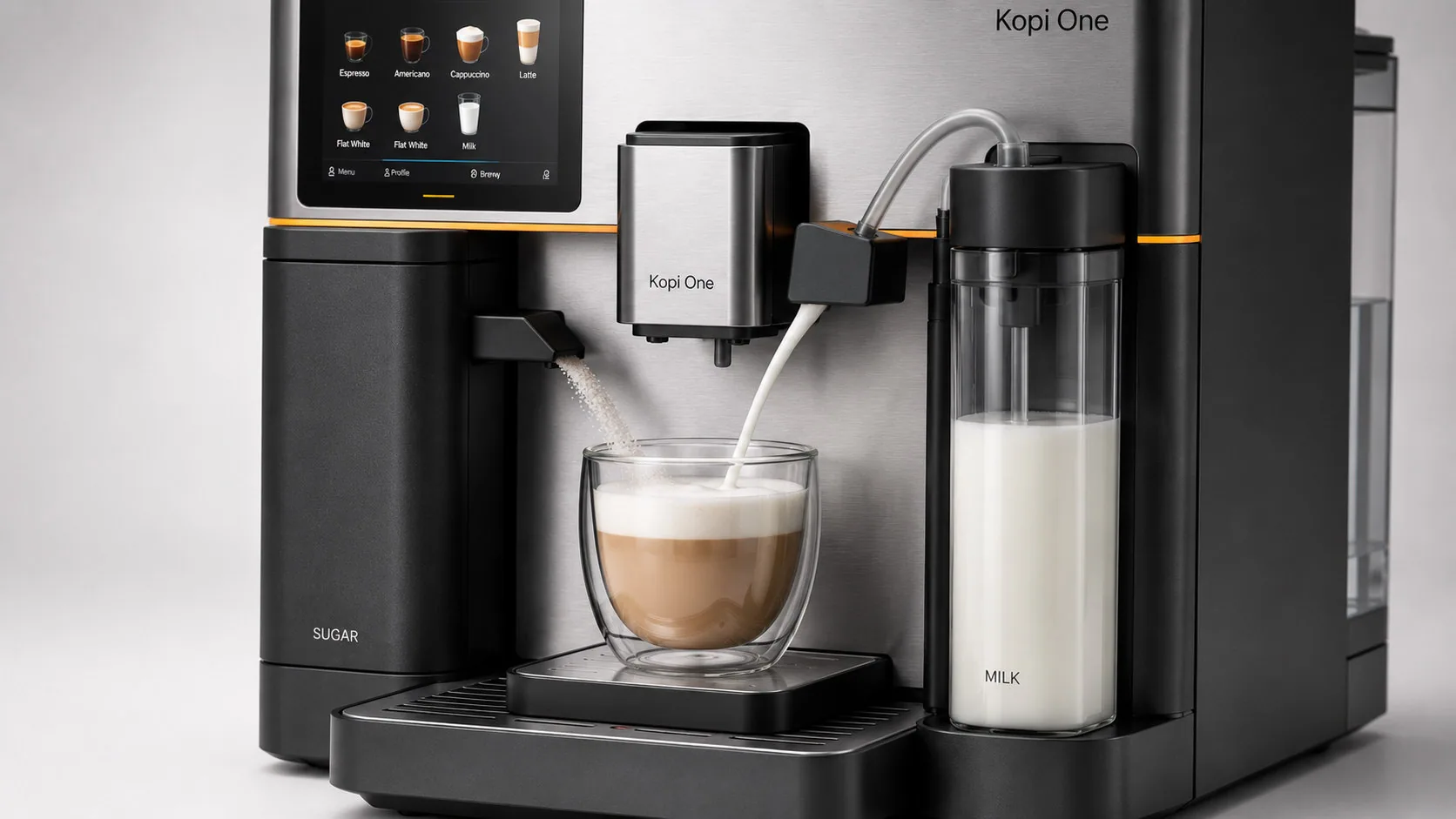
Kopi One was designed around a different product brief: deliver a repeatable cup from whole beans with independently controllable coffee strength, milk quantity and sugar dose — in a compact appliance suitable for homes, offices and hospitality environments.
Engineering detail Show
Four failures we designed against
Multiple containers, spoons and manual additions create inconsistency and mess.
The same beverage changes with operator technique, ingredient timing and portion estimation.
Fully automated commercial machines are costly, large and difficult to service in domestic environments.
Milk and sugar introduce hygiene, residue and moisture challenges that must be designed in from day one.
We decomposed the appliance by engineering risk, then rebuilt it as a controlled system.
Engineering detail Show
Every customer action was translated into flow, thermal, mechanical, electrical and firmware requirements.
Grinder delivery, brew temperature, milk frothing and sugar metering were validated as separate rigs before full integration.
Wet paths, electrical zones, service boundaries and software states were defined before detailed packaging.
Industrial design, mechanical packaging, electronics and firmware evolved together rather than sequentially.
Each design stage closed with measurable test evidence, not only CAD or rendered appearance.
Tooling, assembly sequence, cleaning access, test points and supplier constraints were considered throughout.
Core Surge Robotics principle
A coordinated bean, water, milk and sugar platform.
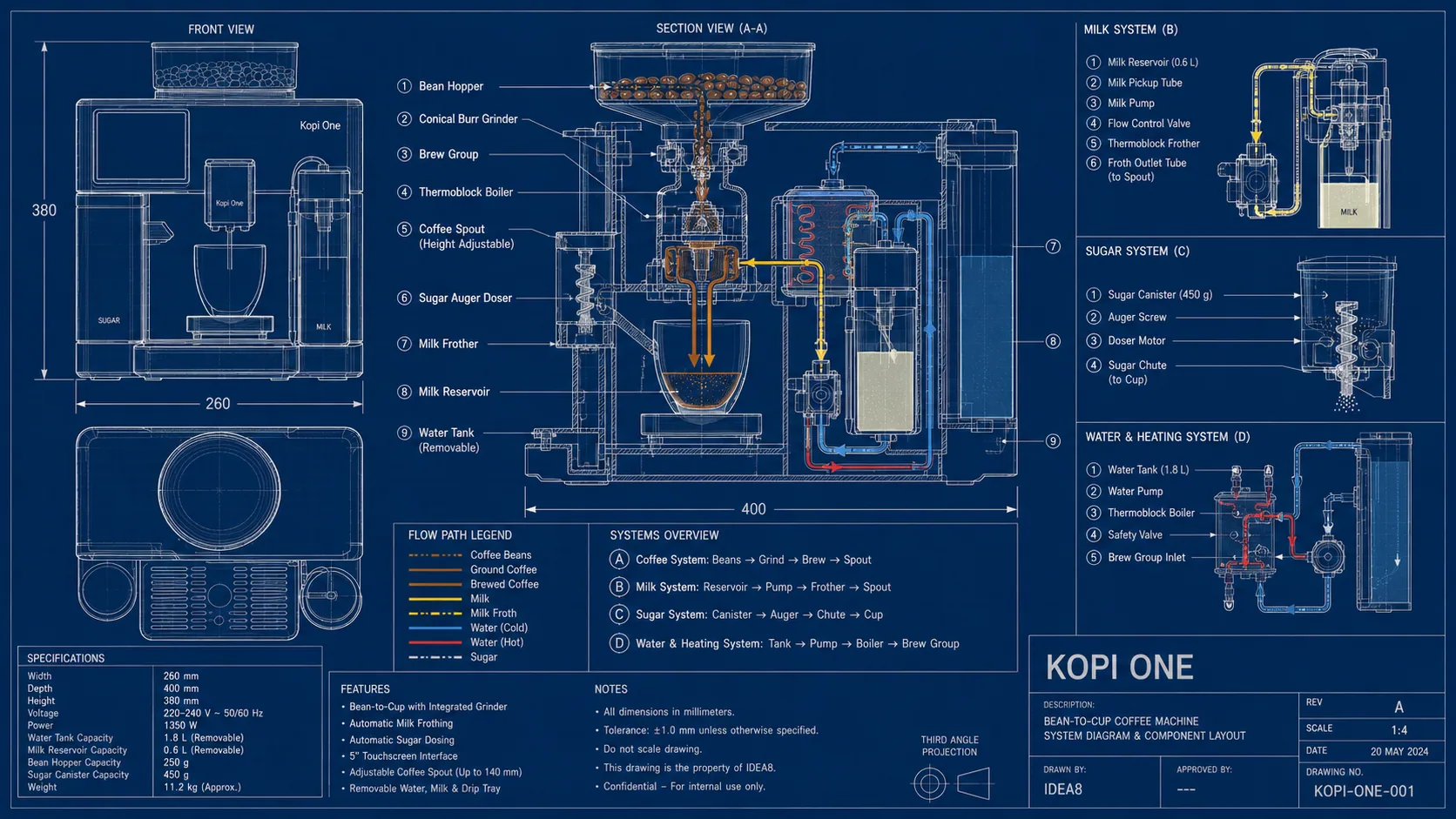
Every drink is the result of five independent physical paths orchestrated by a single control layer. Each path was defined, sized and validated separately before being merged into the appliance.
Engineering detail Show
Hopper → burr grinder → brew group → spout.
Tank → pump → thermoblock → brew group.
Reservoir → pump → frother → cup.
Canister → auger → chute → cup.
Touch UI → recipe engine → sensors and actuators.
The recipe engine synchronises physical processes into one repeatable cup.
The full drink sequence is handled as a deterministic state machine. Each transition requires valid sensor conditions, preventing a UI command from directly energising heaters, pumps or motors without safety interlocks.
Engineering detail Show
Drink type, strength, milk and sugar are loaded as a controlled parameter set.
Reservoir states, temperature, service doors and fault conditions are evaluated.
Grinder runtime and brew-group loading create the programmed coffee dose.
Water is heated, metered and driven through the compressed coffee bed.
Milk and sugar are sequenced, the system purges and the UI confirms completion.
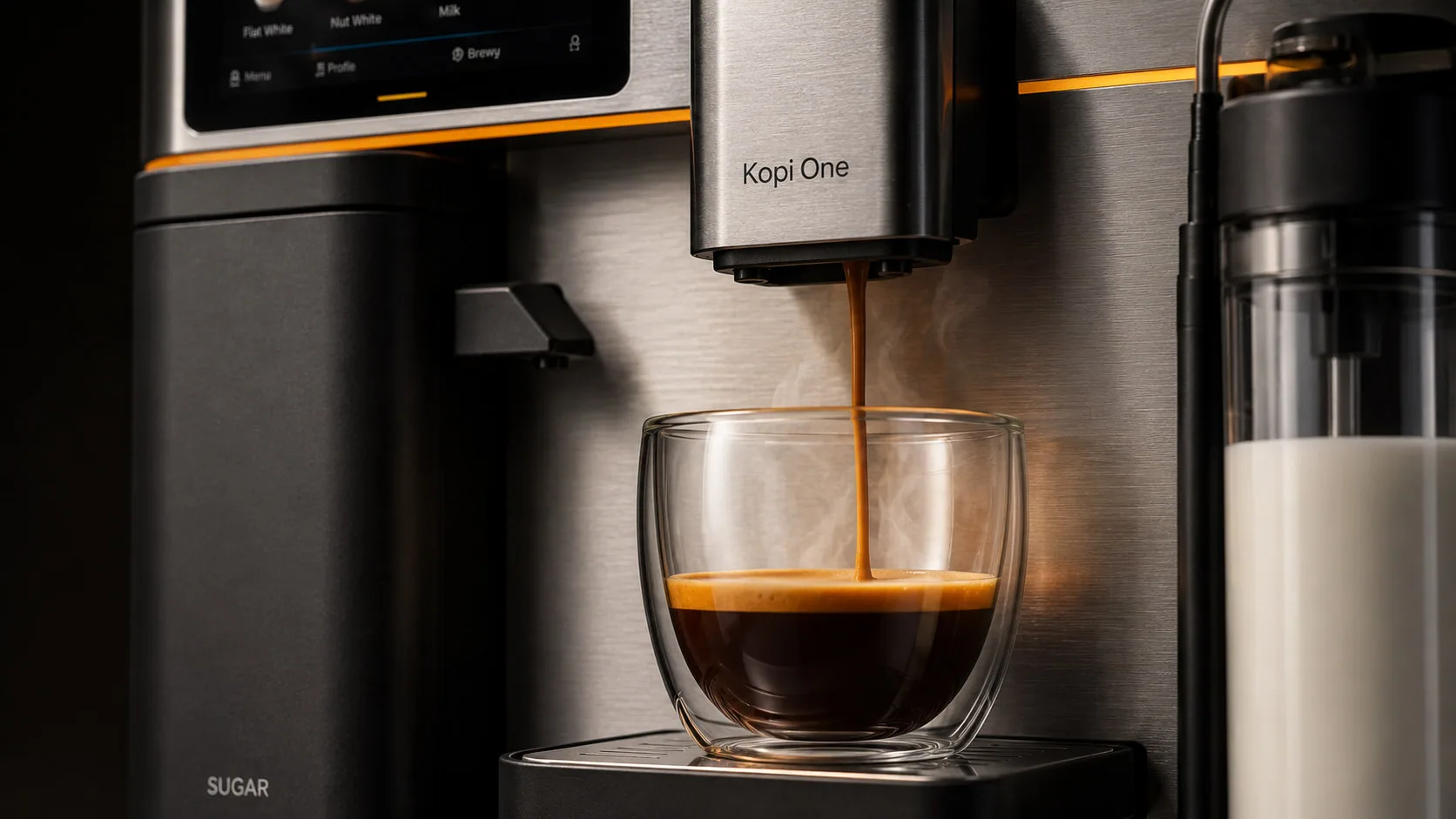
From whole bean to controlled extraction.
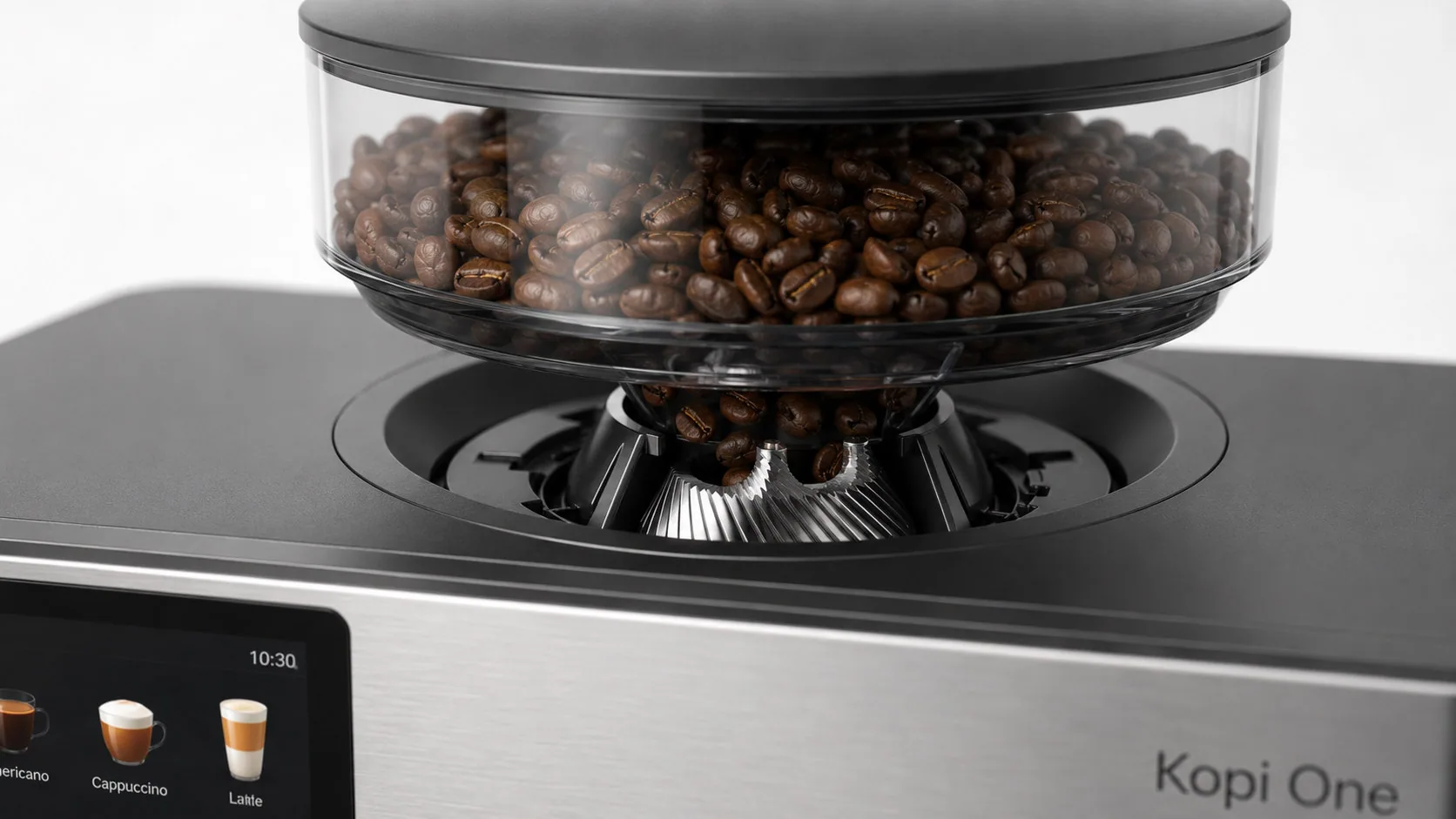
The top-mounted hopper feeds beans directly into a conical burr set, shortening the grounds path and limiting retention. The grinder module was packaged around motor torque, burr alignment, acoustic isolation, service access and controlled discharge into the brew group.
Engineering detail Show
- Grinder timing and motor-current used to detect load, stall and empty-hopper conditions.
- Grounds chute geometry minimises ledges where coffee can accumulate and age.
- Brew-group sealing, compaction and drainage are isolated from grinder and electronics.
- Adjustable recipe strength translated into calibrated grind and water parameters.
- Components exposed to oils and grounds are removable or accessible for planned cleaning.
Key integration risk
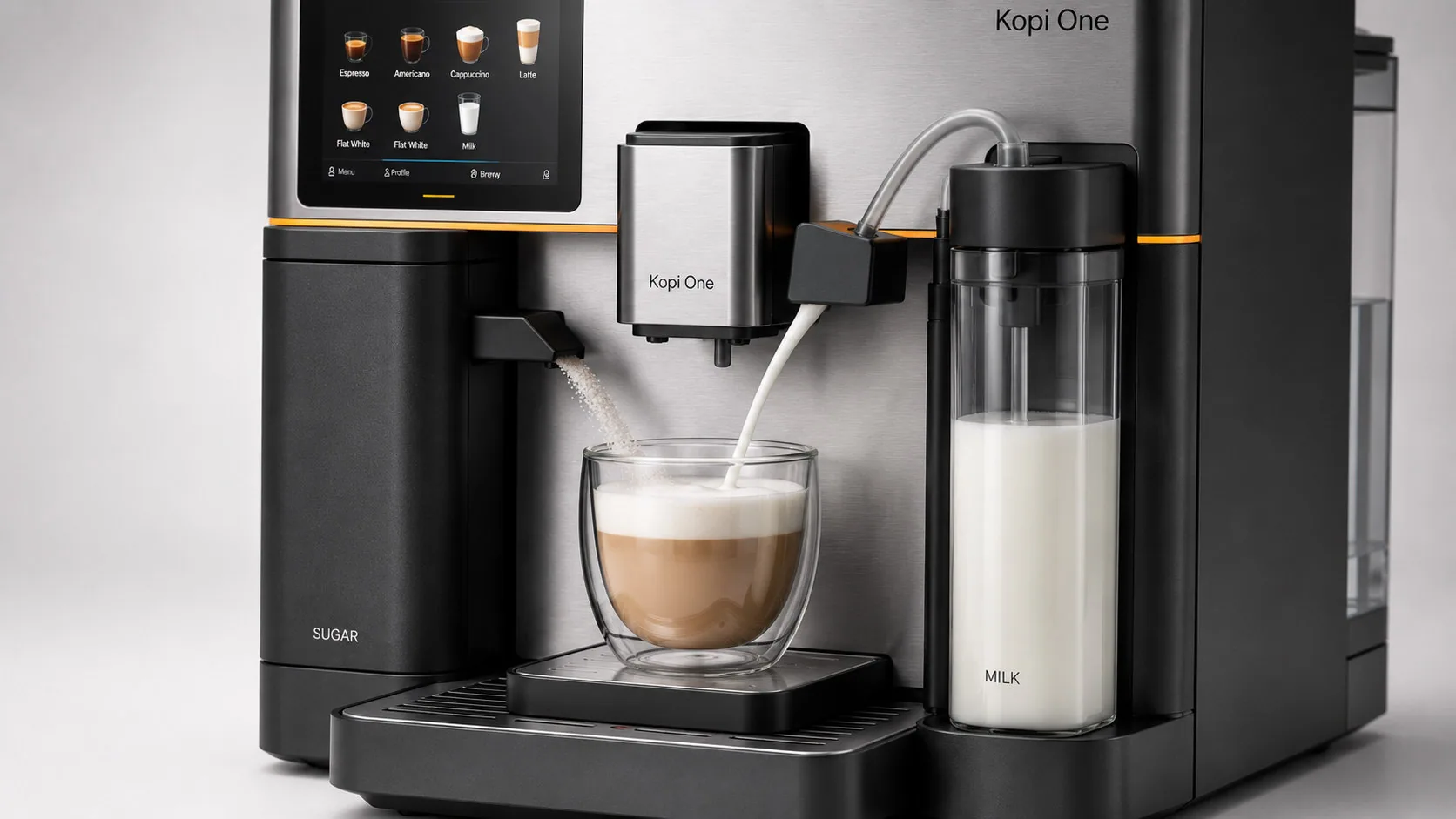
Fresh-milk automation designed around hygiene and repeatability.
Engineering detail Show
The 0.6 L removable milk module is treated as a controlled food-contact system, not an accessory bottle. Pickup, pump, frother, dispense and purge form a closed loop with defined temperature and dwell limits.
- Milk temperature and dwell time limited through firmware and thermal design.
- Routing avoids stagnant low points that retain fluid after purge cycles.
- Interfaces physically separated from sugar and coffee-powder contamination zones.
- Reservoir removable tool-free for refill, cleaning and refrigeration.
Turning a free-flowing ingredient into a measurable machine input.
Sugar is metered by a dedicated auger through a controlled chute geometry. Canister removal is tool-less and the entire subsystem is separated from wet paths to prevent caking and cross-contamination.
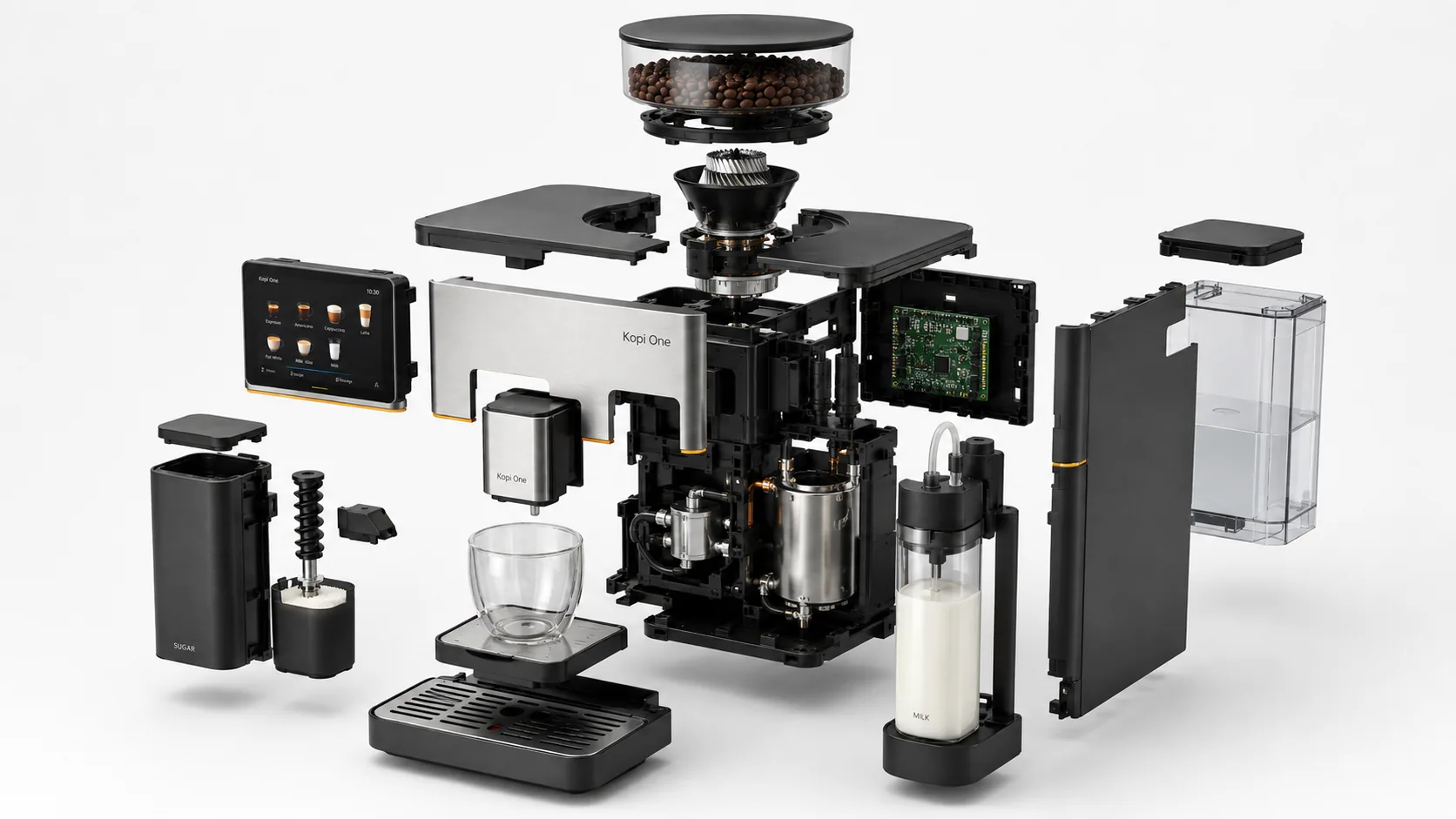
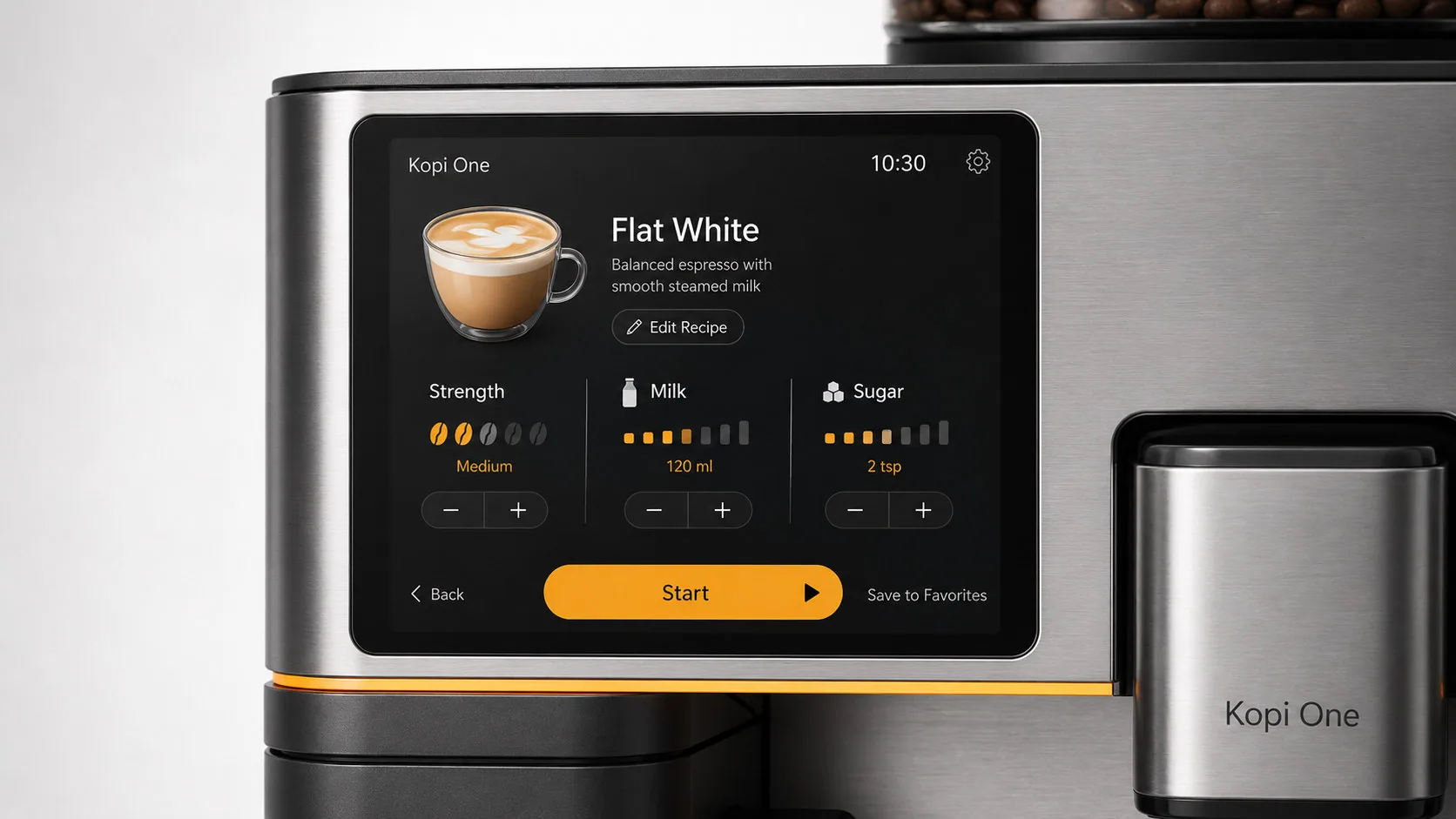
A deterministic state machine driving a physical machine, not a menu.
Engineering detail Show
The firmware separates recipe intent from actuation. Sensor conditions are evaluated at every transition, and a safety chain (thermal fuse, current protection, earth continuity, watchdog) sits underneath the software.
Independent thermal fuse, current protection, earth continuity and watchdog behaviour.
Component actuation tests, error codes, cycle counters and calibration modes.
Heaters, motors, pumps and valves sequenced through a single controlled scheduler.
Appliance defaults to a safe de-energised state; recovery releases pressure, stops heating and guides the user.
Compact packaging organised around heat, water, ingredients and service access.
The chassis is organised as a stack of functional zones. Hot and wet subsystems are contained, side modules for sugar and milk are externally accessible, and a rear service zone keeps electrical entry and the water tank away from the user-facing fascia.
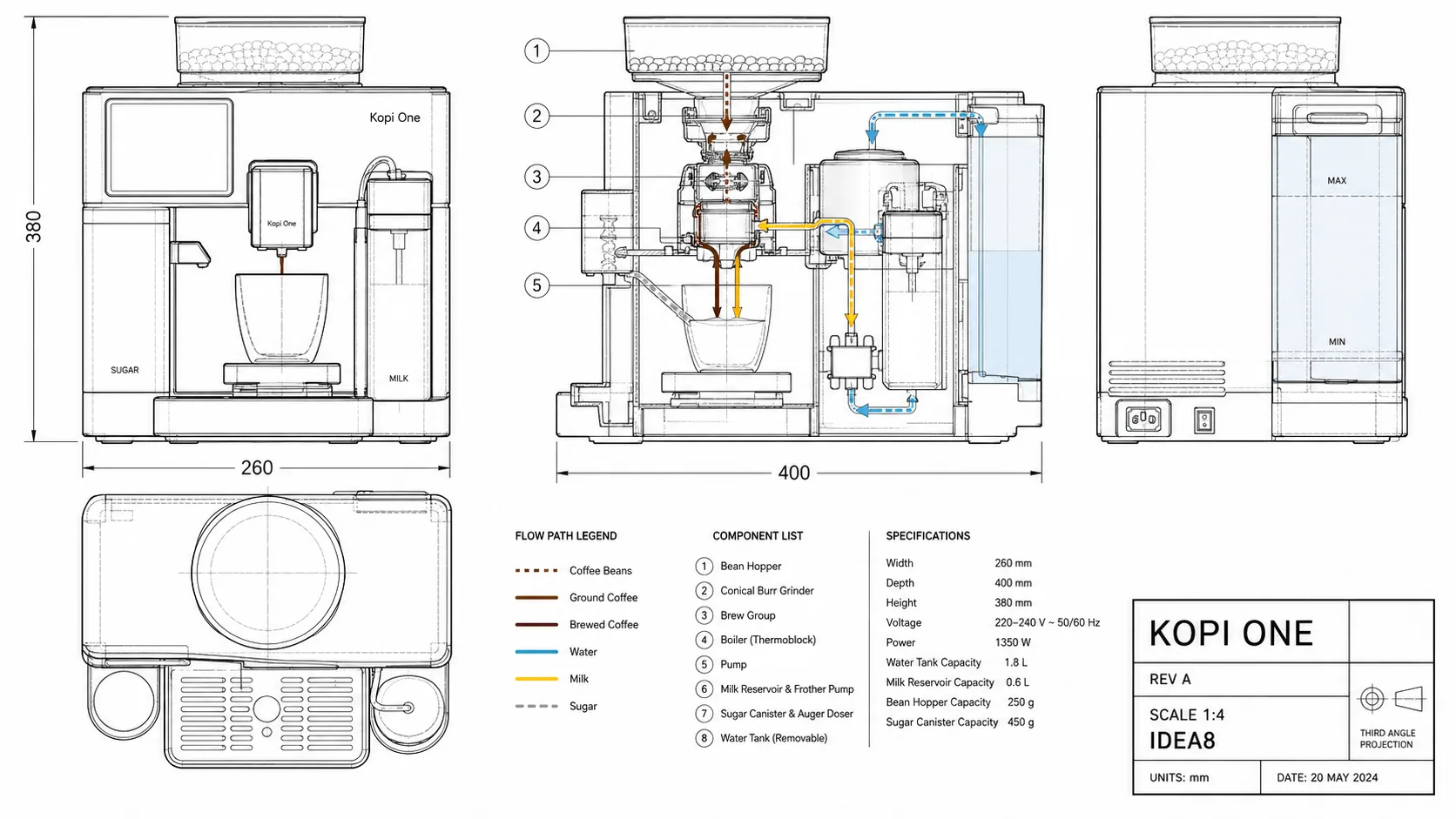
Engineering detail Show
Externally accessible sugar and milk systems for refill and cleaning.
Water tank, power entry and internal access without disturbing the user-facing fascia.
Thermoblock, brew group and electronics packaged as separated thermal domains.
Drip tray, spout height and lighting engineered for cup ergonomics.
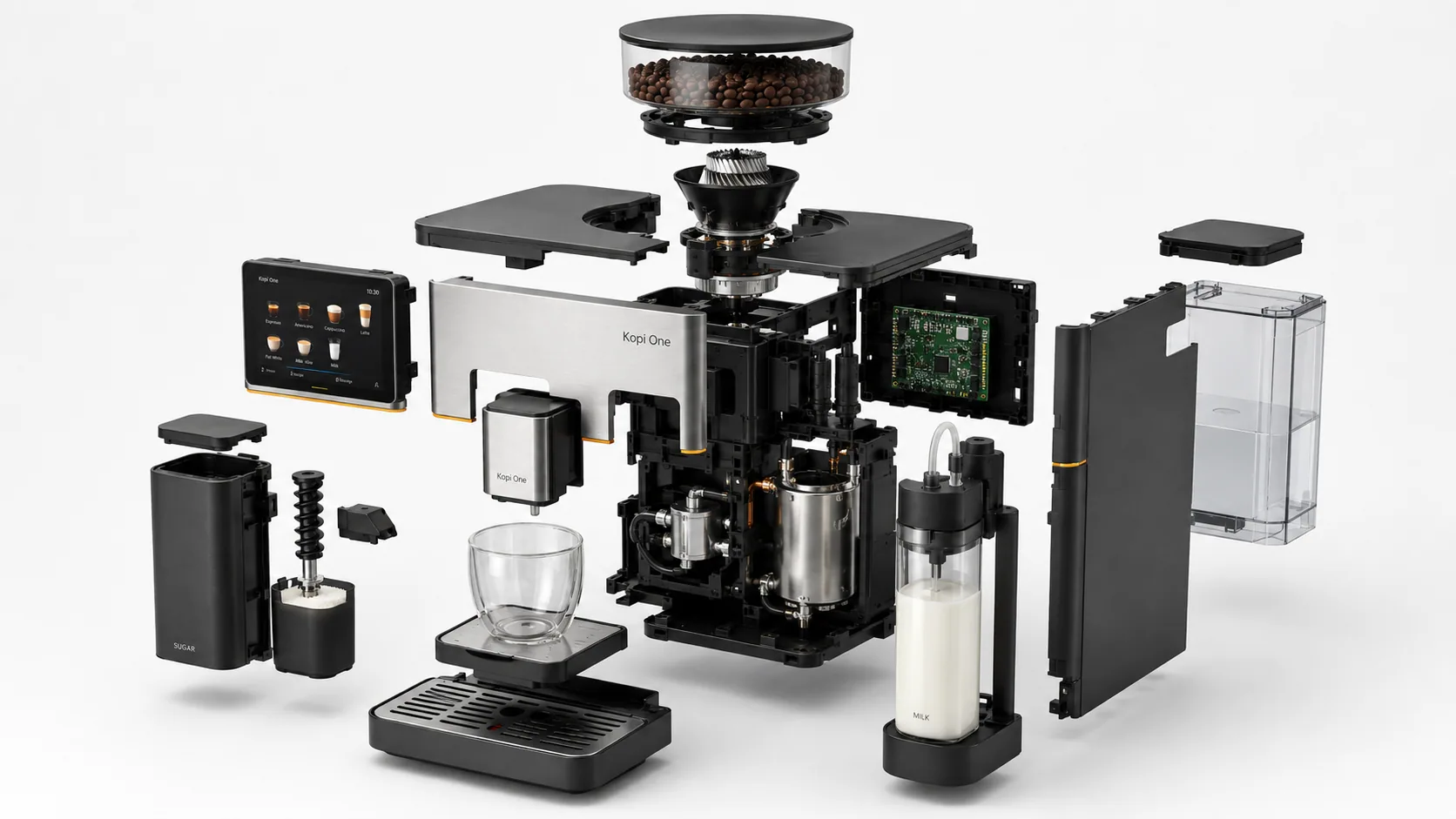
Part architecture, tolerance control and assembly discipline as a released system.
Engineering detail Show
Structural, cosmetic, food-contact and service parts were separated by function and manufacturing process. Tolerances, connector keying, calibration retention and end-of-line test routines were included in the engineering package.
Engineering detail Show
Use cases, product requirements, target cost, market positioning and acceptance criteria.
Form, CMF, cup interaction, service access and countertop presence.
Grinder, brew group, thermal, milk, sugar, water, chassis and service architecture.
High-voltage, low-voltage, sensing, motor drive, touchscreen and safety chain.
Deterministic state machine, recipes, fault handling and diagnostics.
Recipe-based interface translating physics into taste and portion controls.
Performance, hygiene, thermal, acoustic, electrical, endurance and user-flow testing.
Production CAD, drawings, BOM, tooling support, fixtures, work instructions and pilot-build release.
Engineering detail Show
01 / w1-2
Product brief & user journeys
02 / w2-4
Requirements & risk register
03 / w3-8
Concept & subsystem prototyping
04 / w6-14
Integrated mechanical & electronic build
05 / w10-18
Firmware, recipes & UI integration
06 / w16-22
Validation & compliance
07 / w20-26
Pilot build & production release
Engineering detail Show
| Risk | System impact | Surge Robotics mitigation |
|---|---|---|
| Cross-domain integration | Coupled thermal, fluid, mechanical and firmware behaviour can hide failures until full assembly. | Subsystem rigs, ICDs and staged integration with measurable gates. |
| Hygiene & food-contact | Milk and sugar residues create long-term reliability and safety risks. | Removable reservoirs, purge cycles, material selection and cleaning-driven mechanical layout. |
| Thermal separation | Heat migration into electronics and user-touch surfaces degrades safety and lifetime. | Thermoblock isolation, structural airflow paths and firmware-limited dwell times. |
| Service complexity | High repair time, assembly errors and inconsistent field quality. | Modular subassemblies, keyed connections, diagnostics and end-of-line test routines. |
A finished appliance built around a complete beverage experience.
Kopi One demonstrates Surge Robotics' ability to combine industrial design, thermal-fluid systems, precision mechanisms, power electronics, embedded control and user experience into one manufacturable product.
Have a smart appliance to build?
Have a product you’d like us to engineer?
Share the product, challenge or technical risk you are facing. We’ll come back with a clear technical next step — no sales pitch disguised as discovery.